Norm Law Tax Bytes: Rev. Rul. 2026-20
Insight from Norm Law's Tax Practice.
 Monique Gallego, PartnerSep 29, 2026
Norm Law, LLP |Tax Byte | September 29, 2026
Rev. Rul. 2026-20 Taxes Certain ETF Seed Transfers; Notice 2026-62 Reviews Fund Strategies
On September 28, 2026, the U.S. Department of the Treasury (“Treasury”) and the Internal Revenue Service (the “IRS”) issued Revenue Ruling 2026-20 (the “Ruling”) and Notice 2026-62 (the “Notice”).[1]
The Ruling
As part of one plan, four steps take place:
- An investor contributes a diversified portfolio of appreciated securities to a newly formed exchange-traded fund (“ETF”) that is a regulated investment company for U.S. federal tax purposes (“RIC”). The transfer is intended to be tax-free to the contributing investor under § 351.
- The ETF issues shares to an authorized participant (“AP”) in exchange for securities that fit the ETF’s investment thesis, or cash to buy such securities.
- Shortly after, the ETF redeems the AP’s shares with the investor’s previously contributed securities, in a transaction intended to qualify under § 852(b)(6), tax-free to the ETF.
- 4.The ETF ends up with a portfolio “materially different” from the one the investor contributed.
A RIC, which includes most ETFs, is taxed as a corporation, subject to special rules. Like any corporation, it generally recognizes gain when it distributes appreciated property (§ 311(b)). Section 852(b)(6) turns that rule off for redemptions:
“Section 311(b) shall not apply to any distribution by a regulated investment company to which this part applies, if such distribution is in redemption of its stock upon the demand of the shareholder.”
ETFs rely on this exception routinely when they redeem shares in kind from APs. APs are the financial institutions that create and redeem large blocks of ETF shares directly with the fund.
The Notice calls the above a “§ 351 conversion transaction” (a “§ 351 conversion”).
Section 351 defers gain where an investor has merely changed the form of its ownership. Applying substance-over-form and step-transaction principles, the IRS disregards the ETF’s transitory ownership: the ETF was “merely a conduit” moving the investor’s securities to the AP. The contributed portfolio was already diversified (Treas. Reg. § 1.351-1(c)), but that does not help: the Ruling’s analysis does not turn on § 351(e).
Ruling’s Holding.The investor is treated as making a taxable exchange under § 1001 with the AP, covering the contributed securities that the ETF used to redeem the AP. The result is the same with multiple investors.
The Notice: Transactions Under Review
Beyond the transaction covered by the Ruling, Treasury and the IRS have flagged certain transactions in the Notice, requesting comments. Any possible guidance could apply prospectively or retroactively. The IRS says it may also challenge these on examination under existing law.
Partnerships stacked on the same structure (Notice § 2.03).Section 721(a) generally defers gain on contributions to a partnership.Section 721(b) taxes that gain if the partnership would be an investment company under § 351(e) were it incorporated.
In the structure the Notice describes, investors whose appreciated positions are not diversified contribute them to a partnership, sometimes called an “exchange fund.”The partnership holds at least 20% of its value in property other than stock or securities, intending not to be an investment company. The applicable advisor ensures that the partnership’s securities portfolio is diversified. As part of the same plan, the partnership transfers its securities to an ETF in a § 351 conversion.The Notice points to the Ruling for the conversion treatment. For the contribution to the partnership leg, Treasury and the IRS “continue to consider” guidance that would deny nonrecognition or recharacterize it.
Certain trading strategies (Notice § 3).The Notice describes “tax-aware” funds, which it says tend to be investment partnerships or separately managed accounts (“SMAs”).According to the Notice, some appear to use “technical differences among economically similar financial products or payments, or timing and identification rules” to produce a pattern of capital gain and ordinary loss.
- Mixed-character identified straddles.A foreign currency (“FX”) forward, which produces ordinary gain or loss under § 988(a)(1)(A), is paired with an offsetting regulated futures contract, which produces 60/40 capital gain or loss under § 1256(a)(3). The pair is identified under § 1092(a)(2), and the futures leg is always closed first. If that leg has a gain, the claimed result is material capital gain plus an offsetting ordinary loss. If the futures leg instead has a loss, the fund claims that the loss increases the forward’s basis under § 1092(a)(2)(A), reducing ordinary income or producing an ordinary loss upon settlement of the forward.
- Same-day § 988(a)(1)(B) elections. FX forwards are opened and closed the same day and, by default, produce ordinary gain or loss.After trading ends, the capital election is made only for the forwards that closed at a gain.
- Selective swap terminations.A trader fund without a § 475(f) election (which generally results in ordinary treatment) terminates short-term swaps that have a gain shortly before a scheduled payment and reports capital gain (§ 1234A).It holds swaps that have a loss to the payment date and reports ordinary expense.
Other ETF strategies under review (Notice §§ 2.04–2.06).The Notice also examines certain uses of § 852(b)(6) by RICs involving box spread funds, dividend record-date strategies and strategies intended to avoid the RIC qualifying-income test.
What the Notice does not question.It takes no view on identified straddles with consistent character and holding period results.It cites year-end loss harvesting in a directly held index portfolio as consistent with congressional intent, and says the “tax-aware” label alone is not cause for concern.
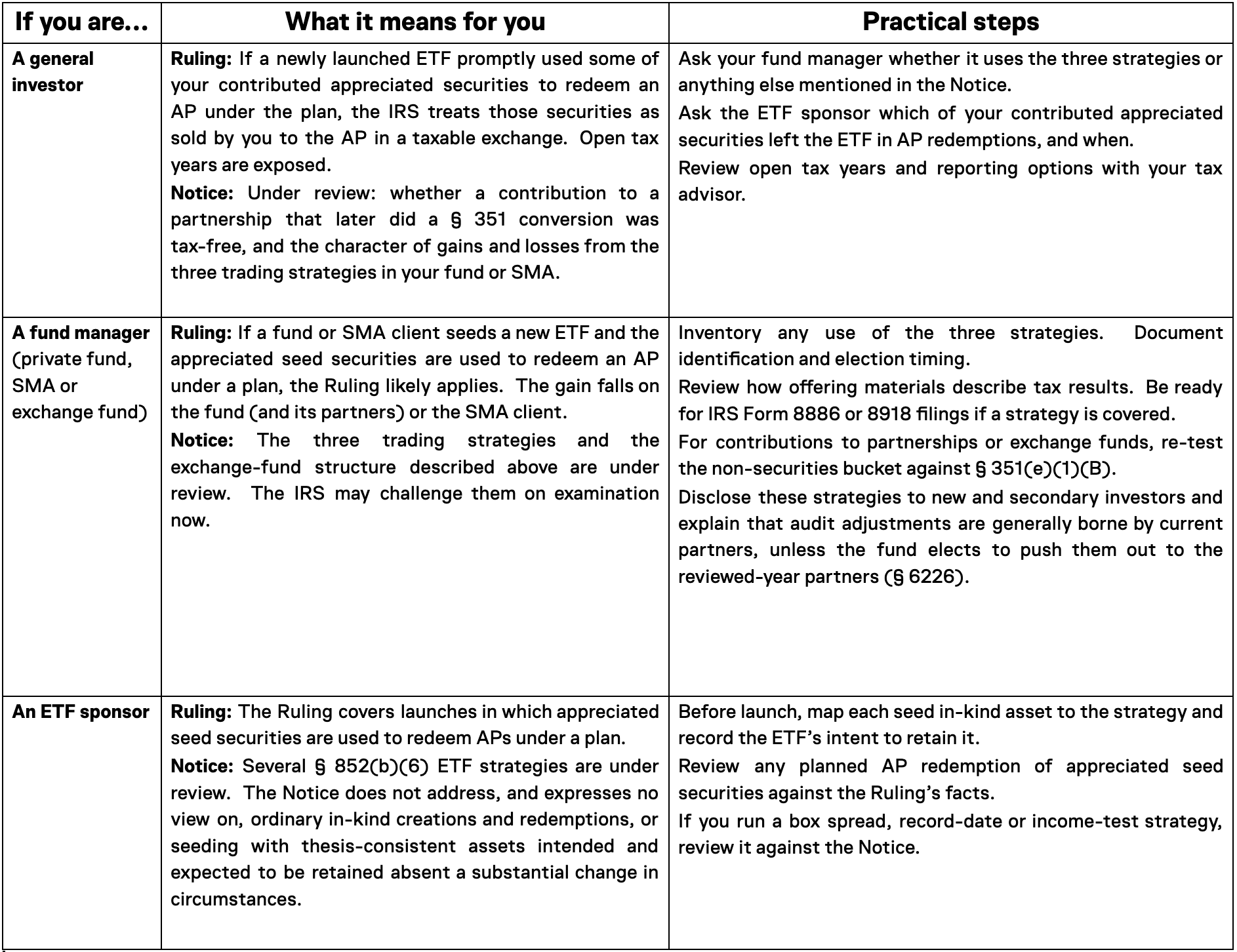
If You Are...
Our View
- 1.The Ruling does not express an effective date.On its face, it can apply to open years.
- 2.Treasury and the IRS ask which similar transactions warrant different treatment, which gives sponsors and managers a chance to differentiate their structures.
Tax Contacts, Norm Law, LLP:
Monique Gallego, Partner, Head of Tax, dgallego@normlaw.com; Nir Fishbien, Tax Counsel, nirf@normlaw.com
General Information Only. Not Legal or Tax Advice. Attorney Advertising.
[1] Unless otherwise noted, “Section” and “§” references are to the Internal Revenue Code of 1986, as amended, and “Treas. Reg. §” references are to the Treasury regulations under it.