Section 892 and the Sovereign Investor
What Does the Exemption Really Mean? A primer for sovereign investors and fund sponsors


Norm Law, LLP | November 2026
Section 892 and the Sovereign Investor – What Does the Exemption Really Mean?[1]
Section[2] 892 of the Internal Revenue Code (I.R.C.) exempts certain U.S. investment income of foreign governments from U.S. tax.[3] The exemption is lost where the sovereign engages in commercial activity (broadly, running a business rather than investing).[4]
For decades, investors relied on temporary regulations. In December 2025, the Treasury Department and the IRS[5] issued final regulations[6] and proposed a second set that would narrow the exemption for lenders and for investors holding governance rights.[7] The rules are now final for partnerships and commercial activity, still largely temporary for eligibility, covered income, control and attribution, and still unclear for credit.[8] A sovereign investor whose U.S. tax position was last reviewed before 2026 may be working from superseded rules, and so may its side letters.
This primer is for sovereign investors and fund sponsors. Part A provides highlights. Part B discusses certain issues in greater depth. Part C lists practical steps.
Part A. Highlights
1. Section 892 is a useful exemption for (a) U.S.-source interest that does not qualify as "portfolio interest," (b) U.S.-source dividends, and (c) gain on stock of U.S. real property holding corporations. Portfolio interest (broadly, interest that is not "contingent interest" on registered debt paid to a lender that is not a 10% shareholder), bank deposit interest, ordinary (non-U.S. real property related) stock gain and certain small traded positions (even if U.S. real property related) are generally not taxed under other provisions of the I.R.C. You must ask yourself whether the projected income and/or gain from an investment requires section 892. Is it a "must-have" or merely a backup "nice-to-have"?
2. Section 892 does not exempt income or gain from direct U.S. real estate or gain on selling a partnership interest.
3. Avoiding commercial activity protects an investor's status. It does not make commercial income, or income outside the privileged categories, exempt. Rent from a net-leased building, a fund's commercial income and income from a cured "inadvertent" commercial activity all remain taxable.
4. The legal form of the investing entity impacts how much is at risk. A controlled entity (a separate entity wholly owned by the government, such as certain sovereign wealth funds) that engages in commercial activity anywhere (not just in the United States) loses the exemption for all of its income for the year. An integral part of the government (such as a ministry) does not need to worry about this issue.
5. A fund investment could cause a controlled entity to lose its exemption. Assuming the fund is structured as a partnership for U.S. federal income tax purposes, that fund's commercial activity is attributed to the controlled entity investor unless the fund interest is a "qualified partnership interest" or QPI (broadly, a truly passive limited partner interest). If the fund is merely an investor or trader in securities and is not a dealer, there is little risk of losing the exemption whether or not the controlled entity owns a QPI. If the controlled entity needs its fund investment to be a QPI to protect its section 892 status, it needs to focus on all its rights; it cannot merely rely on the label, "limited partner."
6. The 5% safe harbor for passive fund interests is measured across every arm of the sovereign, fund by fund. Thus, two agencies of the same sovereign, each holding 3% of the same fund, are treated as holding 6% and so fall outside the safe harbor.
7. One arm of a sovereign can "taint" another. If any arm's interest in a fund fails, every arm's interest in that fund fails, and, if the fund conducts commercial activity, each affected controlled entity loses the exemption across its whole portfolio.
8. "Inadvertent" mistakes can be cured, but only if (a) adequate written procedures are already in place, (b) the commercial activity is discontinued within 180 days of its discovery, and (c) records of the activity and the cure are kept.
9. The final rules apply now (for a calendar-year investor, from 2026), including to existing holdings and side letters. There is no "grandfathering."
10. Private credit may be the next area of concern. If the December 2025 proposal is finalized as drafted, acquiring debt would be commercial activity unless a safe harbor or an investment test applies, and a direct lending program inside a controlled entity would cost that entity the exemption across its whole portfolio. A June 2026 proposal would keep the current rules for loans made, or subject to a binding commitment, before the new rules take effect.
Part B. Discussion
1. The Four Questions, and the Year They Apply To
Every section 892 analysis asks four questions:
(a) is the foreign government investor investing through an integral part (e.g., a ministry) or a controlled entity that meets every requirement of the regulations;[9]
(b) does the projected income and gain from the investment require the section 892 exemption;
(c) might the exemption be lost because the potential income or gain comes from commercial activity, is received by a controlled commercial entity (CCE), is received directly or indirectly from a CCE, or comes from selling an interest in a CCE;[10] and
(d) what withholding, reporting and filing obligations remain.
Which tax year is being evaluated? The final regulations apply to taxable years beginning on or after December 15, 2025, which is 2026 for a calendar-year investor. An investor can elect to apply them to an earlier open year only if it and its related entities apply the final rules in their entirety to that year and all later years.[11] Taxpayers were permitted to rely on the 2011 proposed regulations until the final regulations were issued.[12]
A "controlled entity" is a wholly owned government entity that meets the definitional requirements of the section 892 regulations and can claim the section 892 exemption. A CCE, on the other hand, is any entity engaged in commercial activity, inside or outside the United States, in which the government holds "50 percent or more" by value or vote, or any other interest giving it effective control.[13] Exactly 50% is, therefore, enough. A CCE cannot claim the section 892 exemption. A partly owned operating company, or a partnership, can be a CCE without ever having been a controlled entity.[14]
2. How Important Is Section 892 to the Investment Strategy?
A common error in sovereign structuring is to assume that losing section 892 necessarily means paying U.S. tax. Often, that is not the case. Without section 892, a sovereign is generally taxed as a foreign corporation.[15]
U.S.-source dividends, and interest that is not otherwise exempt, bear a 30% withholding tax.[16] Section 892 provides the most benefit in respect of such income. Income effectively connected with a U.S. trade or business (ECI) is taxed at 21% on a net basis, plus branch profits tax (broadly, a further 30% tax on U.S. business earnings not reinvested in the United States).[17] Section 892 does not exempt income from commercial activity, but "commercial activity" income and ECI are different concepts. Gain on a U.S. real property interest (USRPI) is treated as ECI,[18] yet gain on stock of a U.S. real property holding corporation (USRPHC) can still be exempt under section 892 if the corporation is not a CCE.[19]
Much U.S. investment income is not taxed even without section 892. Most interest on registered debt is exempt "portfolio interest" for any foreign lender, sovereign or not, unless the lender is a 10% shareholder or a bank lending in the ordinary course, or the interest is contingent.[20] Bank deposit interest is also exempt, provided it is not ECI.[21] A foreign corporation with no U.S. business is generally not taxed on gain from selling U.S. stock, except under the Foreign Investment in Real Property Tax Act (FIRPTA). It is taxed, however, on gain from selling an interest in a partnership that has a U.S. business, to the extent the partnership would have had ECI on a sale of its assets.[22] Trading in stocks or securities for one's own account is not a U.S. trade or business, unless done as a dealer.[23]
Stock of a regularly traded class is a USRPI only for a holder of more than 5% of such class, or more than 10% of such class for a real estate investment trust (REIT).[24] A similar more than 10% threshold applies to capital gain distributions in respect of a class of REIT stock regularly traded on a U.S. securities market.[25]
Section 892 does not preclude income tax treaty relief. Section 892(a)(3) extends treaty access to a foreign government only if its country gives the U.S. government equivalent treatment.[26] Finally, a qualified foreign pension fund (QFPF) is generally exempt from FIRPTA.[27] The FIRPTA rules cover gain on direct U.S. real property, which section 892 never exempts.[28]
How Useful Is Section 892?
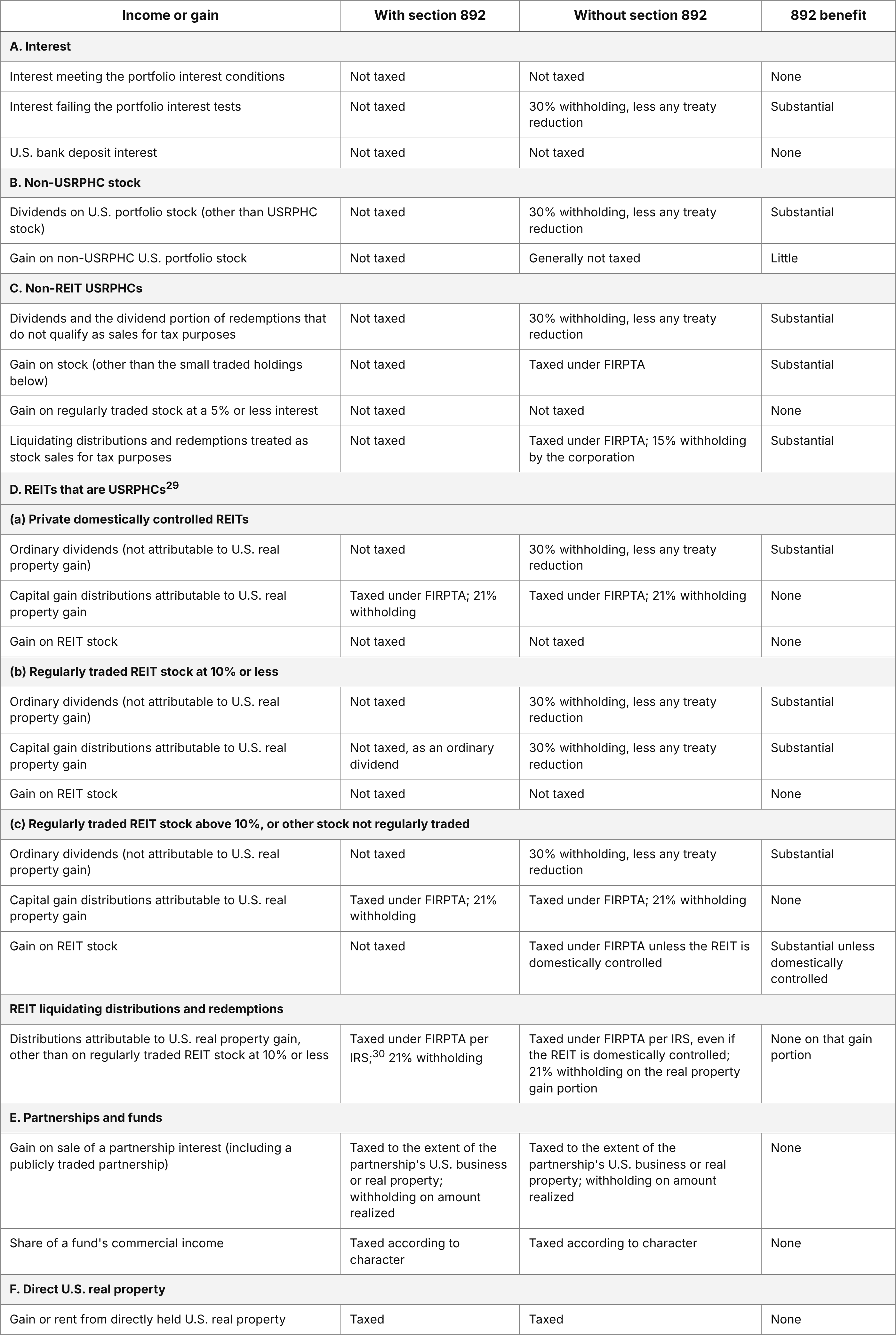
The table compares a sovereign eligible for section 892 with an ordinary foreign corporation and assumes that neither the issuer nor the investor is a CCE. First, a redemption is a sale only if it meets one of the section 302(b) tests (broadly, if it meaningfully reduces the holder's interest); otherwise, it is a dividend to the extent of the corporation's earnings and profits (its profits as measured for tax purposes), which section 892 also exempts.[31] Second, the IRS treats a REIT distribution attributable to the REIT's gain on U.S. real property, including a liquidating distribution, as FIRPTA gain that section 892 does not reach.[32] Third, a capital gain distribution on a class of REIT stock regularly traded on a U.S. securities market, to a holder of 10% or less of that class at all times during the year ending on the distribution date, is treated as an ordinary dividend, not FIRPTA gain,[33] so section 892 exempts it.
In short, section 892 is mainly a dividend and USRPHC-stock exemption, plus a backstop for interest that fails the portfolio interest tests. Where section 892 is merely a "nice-to-have," it still offers the convenience of a single Form W-8EXP (the form a foreign government gives a withholding agent to claim the exemption). In a large portfolio, such a convenience can also provide administrative cost savings.
3. Which Investors Qualify
Who is a foreign government? Only an "integral part" or a "controlled entity" of a foreign sovereign.[34]
An integral part is a governing authority of a foreign country, however designated, whose net earnings are credited to the sovereign with no private benefit.[35] A controlled entity is a separate entity that is (a) wholly owned and controlled by a single foreign sovereign, directly or through other controlled entities, (b) organized under that sovereign's laws, (c) structured so that its net earnings go to its own or the sovereign's accounts, with no private benefit, and (d) required to vest its assets in the sovereign on dissolution.[36] It "does not include partnerships or any other entity owned and controlled by more than one foreign sovereign."[37] The Treasury Department and the IRS read this to exclude every partnership, including one whose only partners are arms of the same sovereign (two of its controlled entities, for example), and have proposed to say so expressly.[38] Thus, such a partnership should not be assumed to be a controlled entity; its partners are tested instead.
Why does the form matter? A controlled entity that engages in commercial activity anywhere becomes a CCE and loses the exemption on all of its income. An integral part cannot be a CCE; it loses the exemption only on its commercial income, income from CCEs and gain on selling interests in CCEs. In the regulation's example, a ministry that is an integral part runs a U.S. business and also holds listed stocks and bonds. "[T]he Ministry's income from the stocks and bonds is exempt from U.S. tax,"[39] except for dividends from a holding company it controls whose subsidiary runs a business.[40] Were the ministry a controlled entity, "none of its income is eligible for exemption."[41]
A separately organized government pension trust is a controlled entity only if (a) it exists exclusively for government employees and former employees (or for them and non-government employees who perform governmental or social services), (b) its trustees are government employees or appointees, (c) it pays retirement, disability or death benefits for prior services, and (d) its income satisfies the government's obligations to participants rather than benefiting private persons.[42] A plan that allows unlimited employee contributions does not qualify.[43] A pension trust that engages in commercial activity is not a CCE if it earns only income on which it would not be taxed were it a U.S. qualified pension trust.[44] Thus, a pension trust that owns a shopping center "leased and managed by an independent real estate management firm" is not a CCE, although the rent is not exempt, since it is not covered income.[45] Note, however, that debt-financed income can change that result.
A business entity wholly owned by a foreign government, or by an integral part or controlled entity, is a corporation for U.S. tax purposes.[46] Thus, a vehicle wholly owned by one arm of the sovereign is a corporation, never a disregarded entity, and a "sovereign-owned partnership" can exist only where two or more arms of the same sovereign are its partners.[47] The December 2025 proposal assumes such partnerships exist but does not discuss whether the corporation rule reaches a vehicle owned by two arms of one sovereign.[48] It may be worth confirming that each investing entity's file contains (a) the enabling statute or decree, (b) an ownership chart up to the sovereign, (c) the earnings and dissolution provisions, (d) a description of what the entity actually does, and (e) any needed local law analysis. A "sovereign wealth fund" label on a subscription agreement does not, by itself, establish that the entity qualifies.
4. Which Income Qualifies
The covered categories are income from U.S. stocks, bonds and other securities (which include loans), income from financial instruments held in the execution of governmental financial or monetary policy, and interest on U.S. bank deposits.[49] Securities income includes gain on disposition and securities lending income.[50]
Three exclusions are worth highlighting. First, rent and gain from directly held U.S. real property are never covered. Second, gain on selling an interest in a partnership or trust is not covered, even if the partnership is publicly traded.[51] Third, market-standard derivatives are now "financial instruments,"[52] but the income qualifies only if they are held for a governmental financial or monetary policy purpose. A central bank's reserve portfolio usually has such a purpose; a return-seeking derivatives book usually does not.
Whether an activity is "not commercial" and whether its income is "exempt" are separate questions. Holding a net-leased building is not commercial activity,[53] so the sovereign keeps its section 892 status, but the rent is not covered income and is taxed.[54]
5. Commercial Activity, and Relief for Honest Mistakes
What is commercial activity? All activities "ordinarily conducted for the current or future production of income or gain," wherever conducted. "[O]nly the nature of the activity, not the purpose or motivation" matters.[55]
Investing in securities, loans and financial instruments, holding partnership interests and bank deposits, securities lending, and holding net leases are not commercial activity.[56] Neither is trading for one's own account, unless done as a dealer.[57] However, investments (including loans) made by a banking, financing or similar business are commercial activity.[58]
An entity that "engages in commercial activities at any time during its taxable year" is a CCE "for its entire taxable year," and its activities in the immediately preceding year are taken into account to the extent relevant in characterizing the current year's activities.[59] Its own investment income then loses the section 892 exemption, as do payments the sovereign receives from it and gain on the disposition of its shares.[60] A corporation that acquires a commercially active target's assets in a tax-free liquidation or reorganization to which section 381(a) applies generally is not tainted for that year solely by holding them, if (a) the target's taxable year closes in the transaction, (b) the acquirer does not directly continue the activity, and (c) the two corporations are not controlled by the same sovereign.[61]
Private credit is the open question for sovereign investors. Under the December 2025 proposal, acquiring debt would be commercial activity unless it is acquired in a registered offering through unrelated underwriters, in a qualified secondary market acquisition, or as an investment under a facts and circumstances test.[62] If the proposal is finalized as drafted, a controlled entity that solicits and negotiates loans would become a CCE, as the proposal's own example of a single negotiated loan shows. A loan to a company in which the lender holds a substantial equity stake may, however, still be an investment.[63] A June 2026 proposal would keep the current rules for debt acquired, or subject to a binding commitment, before the end of a transition period of at least 90 days after the debt rules are finalized. It also confirms that merely holding debt in later years is not commercial activity.[64] The Treasury Department and the IRS also say they are evaluating the comments in light of established market practices and "the general policy to support current and future sovereign wealth fund investment in the United States,"[65] so the debt rules may be softer than the proposal once finalized. If they are not, a separate lending vehicle, below or beside the investing entity, is the structural answer.
Inadvertent Commercial Activity
Inadvertent commercial activity does not cause CCE status if (a) the failure to avoid it was reasonable, (b) it is cured on time, and (c) records are kept.[66] Reasonableness turns on the facts, including the number of activities and their size relative to the entity's income and assets.[67] A failure is not reasonable unless "adequate written policies and operational procedures" are in place and responsible employees make reasonable efforts to follow and enforce them.[68] Adequacy turns on whether the policies (a) prohibit commercial activity, directly and through investments, (b) are communicated in writing to everyone with investment authority, (c) require an advance determination, by opinion of counsel or otherwise, of whether an investment is commercial activity, (d) include an annual audit or review, and (e) require periodic results to be certified by employees with authority to cure.[69]
With the procedures in place, a failure is treated as reasonable if commercial activity assets are no more than 5% of total assets (on the average of quarter-end values) and commercial activity income is no more than 5% of gross income.[70] Above 5%, whether the failure was reasonable depends on all the facts and circumstances.[71] Commercial activity attributed from a partnership counts proportionately,[72] and QPIs count in the totals but not as commercial activity.[73]
Cure requires discontinuing the activity "within 180 days of the date of discovery of the commercial activity by responsible employees." For a fund interest, that can be done by disposing of the interest (including to a related entity), by the partnership stopping the activity, or, depending on the facts, by exchanging the interest for a QPI in the same partnership, "including a deemed exchange from an agreed modification of terms."[74] A side letter renegotiation can, therefore, be a cure, depending on the facts.
Two limits apply. First, income from the inadvertent commercial activity still does not qualify for the section 892 exemption.[75] Second, a reasonable but mistaken belief that a fund interest is a QPI does not, by itself, qualify the entity for the relief: "whether an entity reasonably concludes that it qualifies for the qualified partnership interest exception is not a factor."[76]
6. Control and Attribution
The first attribution rule counts ownership for the 50% test. Holdings of every integral part and controlled entity of the same sovereign are added together, and corporate holdings are attributed proportionately to shareholders. In the regulation's example, a controlled entity owns 20% of a company that owns 60% of an operating company, and a government bureau owns the other 40%. The controlled entity's 12% indirect interest plus the bureau's 40% is 52%, so the operating company is a CCE.[77] An interest below 50% still counts if it gives effective control,[78] whether through a large minority stake or through creditor, contractual or regulatory relationships combined with its ownership interest.[79] Board seats, vetoes and investor-level decision rights are all expressly considered in the proposed regulations; the current test does not mention them.[80] Under the June 2026 proposal, the new effective control rules would not apply to an entity in which the sovereign acquired interests before the end of a transition period of at least 90 days after those rules are finalized (or later under a binding commitment made before then). They would apply to that entity only once the sovereign acquires new interests in it that would, by themselves, give the sovereign effective control.[81]
The second rule attributes commercial activity, and only downward: a parent's commercial activity is attributed to its controlled subsidiary, but a subsidiary's is not attributed to its parent, and siblings do not taint each other.[82] In the regulation's example, shown below, G's U.S. bank interest is exempt even though H and S run businesses. Reverse the facts, so that G runs the business and S earns the interest, and "S's interest income is not exempt from taxation."[83] This non-exemption is under section 892 only; the bank deposit interest exemption outside section 892 generally still applies.[84]
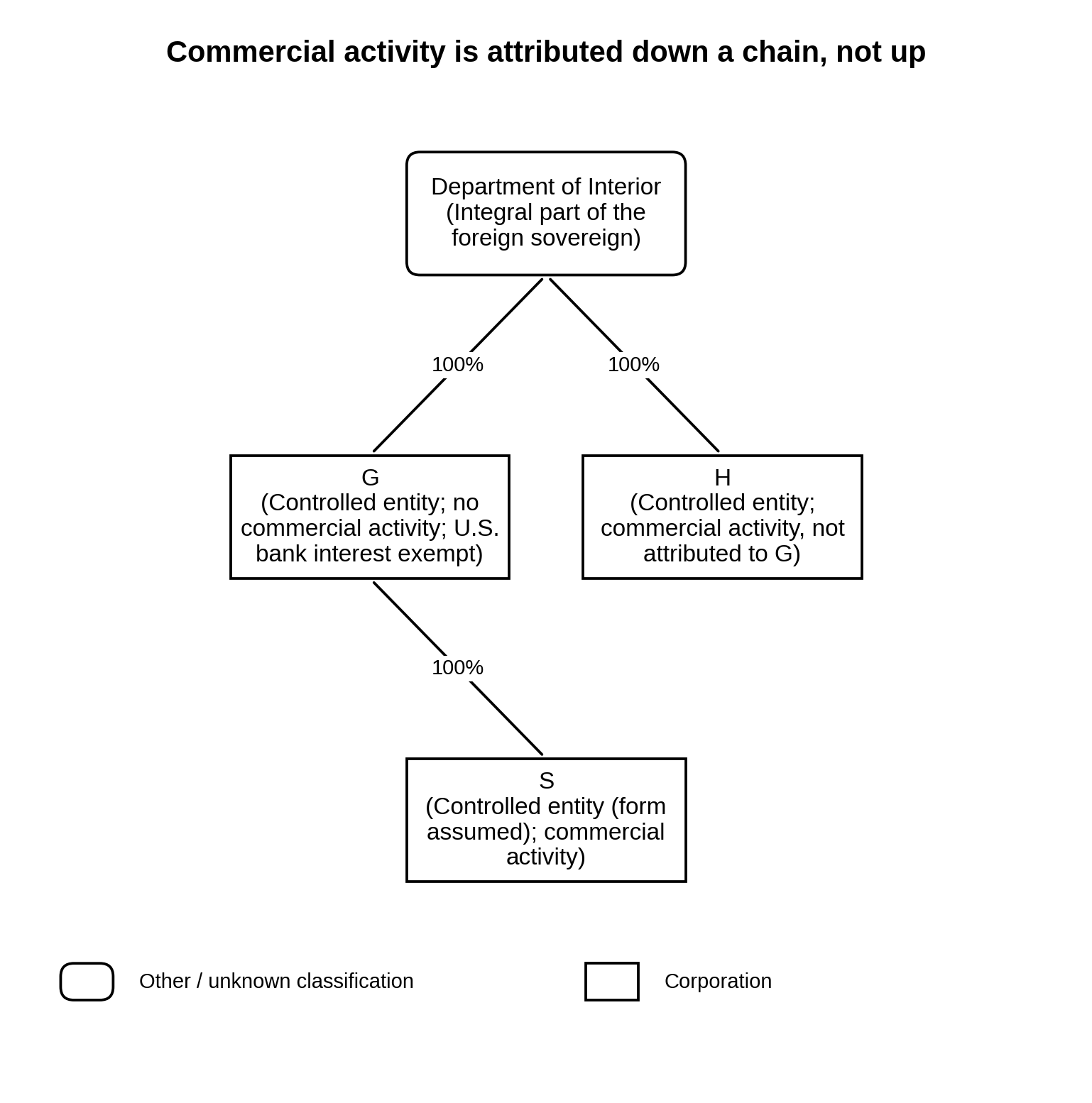
Thus, any commercial activity should be conducted by a subsidiary or a sister entity of the investing entity, never by its parent.
7. Partnerships and Private Funds
A partnership's commercial activity is attributed to its partners, general or limited.[85] Without an exception, even a small, passive interest in a fund that conducts commercial activity makes a controlled entity a CCE. Attribution applies whether or not the sovereign receives or shares in income labeled as a fee.[86] The final regulations also withdrew the old rule that protected partners in publicly traded partnerships from attribution.[87]
There are two exceptions. First, a partner is not treated as engaged in commercial activity solely because the partnership trades stocks, securities, partnership interests, commodities or financial instruments for its own account, assuming the fund is not treated as a dealer,[88] with no percentage cap or rights test. This aligns with the section 864 "trading in securities" safe harbor for non-sovereign non-U.S. investors who are not dealers.[89]
Second, an entity not otherwise engaged in commercial activity (including services for a partnership under section 707(a) or (c)) is not deemed commercially active solely because it holds a QPI. It may, however, be engaged in a U.S. trade or business under section 875(1).[90] An interest is a QPI if the holder (a) has limited liability, (b) cannot bind the partnership, (c) does not control the partnership, and (d) has no right at any time during the year to participate in its management.[91] Management means "the day-to-day management or operation of the partnership's business," such as ordinary-course personnel and compensation decisions, formulating business strategy, or decisions on specific investments.[92] The test looks at "the totality of all rights arising from all direct or indirect interests of the holder," including the partnership agreement, side letters, other agreements and the parties' conduct.[93] A right never exercised can still disqualify the interest.[94] An interest of 50% or more is a controlling interest and can never be a QPI.[95]
Protective Rights Versus Management Rights
Rights to monitor or protect the investor's capital are generally not management rights, as long as they do not reach day-to-day operations or give effective control.[96] The regulations list examples of such protective rights: admitting or removing a partner, hiring or firing key strategic personnel, amending the partnership agreement, dissolution, merger or conversion, unusual departures from investment parameters, extending the term, and selling substantially all of the partnership's assets outside the ordinary course.[97] The final regulations "do not provide an exclusive list of rights" and instead call for "a holistic review taking into account all the facts and circumstances."[98]
The regulations provide two examples that illustrate where the line is drawn.[99] A controlled entity (K) holds 20% of a limited liability company, taxed as a partnership, that owns and manages an office building. If a side letter lets K review and advise on the company's material contracts and expenses, K has management rights, its interest is not a QPI, the company's commercial activity is attributed to K, and K is a CCE. If K instead sits on a committee that may only make non-binding recommendations on investor-level matters, such as dissolution and term extension, K is not a CCE (if it has no other commercial activity), although its share of the company's commercial income is still taxed. Thus, what matters is what a committee can decide, and whether its decisions are binding, rather than what the committee is called.
The 5% Safe Harbor
An interest is also a QPI if, at all times during the year, the holder has limited liability, cannot bind the partnership, is not its managing partner or member, and holds no more than 5% of either the partnership's capital or its profits, "directly or indirectly."[100] Both limits must be met, on the combined holdings of every arm of the sovereign. A larger interest, even 20%, can still qualify as a QPI under the general test above.
Aggregation Per Fund Across a Single Sovereign's Arms
Interests the sovereign holds in the same partnership, directly or indirectly, through its integral parts, controlled entities or any other entity it controls, are tested together. If any one of them fails, or they fail when combined, none qualifies.[101] Thus, if one arm takes a general partner stake or an operational seat in a fund, another arm's passive limited partner (LP) interest in that fund fails too. If that other arm is a controlled entity and the fund conducts commercial activity (beyond trading for its own account), that arm becomes a CCE and loses the exemption across its whole portfolio.[102]
Only interests in the same partnership are aggregated, but indirect interests count, so an interest held through a feeder into a master fund counts as an interest in the master fund. The arm whose portfolio needs protecting can hold its LP interest through a blocker, so that the arm loses the exemption only on its income from, and gain on, the blocker.[103]
Tiers, Exits and ECI
If an upper-tier partnership holds only a QPI in a lower-tier partnership, the lower tier's commercial activity is not attributed upward.[104] Note, however, that the upper-tier partnership's share of the lower tier's commercial income keeps its character and remains taxable.
A QPI addresses CCE status only. A foreign partner is engaged in a U.S. trade or business if the partnership is,[105] so a fund's ECI brings net-basis tax, partnership withholding (whether or not cash is distributed) and a U.S. return on Form 1120-F.[106] On a sale of a fund interest, gain is ECI to the extent of the partnership's U.S. business assets[107] and FIRPTA gain to the extent of its U.S. real property,[108] and the buyer generally withholds 10% of the amount realized,[109] which can exceed the tax due (such excess can be refunded upon proper return filing).
8. Blockers
A "blocker" is a corporation placed between the sovereign and the commercial activity, so that the sovereign's only exposure is in respect of income from the blocker and gain on the disposition of its shares, neither of which is exempt because the blocker is a CCE.
A U.S. blocker pays 21% corporate tax on its net income, reduced by any deductible leverage. A foreign blocker may face branch profits tax.[110] Section 892 does not help with interest on a shareholder loan to a blocker: a 10% shareholder cannot use the portfolio interest exemption,[111] and section 892 does not exempt income from a CCE. A REIT in which the sovereign holds 50% or more is generally a CCE, so its dividends are not exempt.
9. Real Estate, FIRPTA and REITs
Section 892 has a mixed impact in respect of U.S. real estate. A sovereign can keep its section 892 status and still pay full FIRPTA tax, because FIRPTA separately taxes gain on a USRPI as ECI.
For leveraged direct holdings, a foreign government may deduct interest only on liabilities booked to its U.S. business, and only to the extent such liabilities do not exceed 80% of the value of its U.S. assets; the rule "does not apply to controlled commercial entities."[112]
A USRPHC "is treated as engaged in commercial activity and, therefore, is a controlled commercial entity" if the sovereign holds 50% or more or has effective control,[113] in which case its dividends and the exit gain are both taxed. The final regulations narrowed this rule in two respects. It no longer applies to foreign corporations, or to a corporation that is a USRPHC "solely by reason of its direct or indirect ownership interest in one or more other corporations that are not controlled by the foreign government."[114]
REITs That Are USRPHCs
REIT capital gain distributions attributable to the REIT's sales of U.S. real property are FIRPTA gain and are not exempt,[115] unless the traded-stock threshold applies. Withholding on them is at the highest corporate rate, currently 21%, not the 15% that applies to sales.[116]
What about a liquidating distribution? The IRS position, set out in a 2007 notice, is that FIRPTA applies and section 892 does not.[117] A foreign investor can sell stock of a domestically controlled REIT free of FIRPTA, yet the IRS's view is that a liquidating distribution from the same REIT is taxed to the extent attributable to the REIT's U.S. real property gains. The notice said that "Treasury and the IRS intend to issue regulations"[118] on the point, but none have been issued. Thus, the form of the exit matters, and the IRS position could change.
A REIT is domestically controlled if foreign persons held less than 50% of its stock, by value, at all times during the testing period (generally the prior five years).[119] Stock of a domestically controlled REIT is not a USRPI, so gain on its sale is outside FIRPTA.[120] A QFPF and a foreign government count as foreign persons for this test, despite their exemptions.[121] Final regulations issued in 2024 look through a private domestic C corporation that is more than 50% foreign-owned, with transition relief for existing REITs.[122] An October 2025 proposal would withdraw that look-through rule,[123] and taxpayers may rely on the proposal for transactions before it is finalized.[124]
10. Government Pension Funds
A government pension fund may qualify under two separate regimes: (a) section 892, as a pension trust that is a controlled entity (Part B.3 above) or as a pension fund that is merely a separate account of an integral part or controlled entity,[125] and (b) the QFPF exemption from FIRPTA (Part B.2 above). It should be tested under both, because each covers income or gain that the other does not. Section 892 exempts dividends and interest, but not FIRPTA gain on direct U.S. real property or on REIT distributions of real property gain. The QFPF rule removes from FIRPTA a qualifying fund's gain on a USRPI, including USRPHC stock and "gain from a distribution described in section 897(h)."[126] The QFPF rule does not reach dividends or interest. Neither regime exempts ECI from an operating business.
A QFPF must (a) be organized under foreign law, (b) be established by a foreign country or by employers to provide retirement or pension benefits, (c) have no participant entitled to more than 5% of its assets or income, (d) be regulated, with information about beneficiaries available to home-country tax authorities, and (e) receive home-country tax preference as a pension fund.[127] At least 85% of its expected benefits must be retirement and pension benefits.[128]
Three further points are worth noting. First, a fund is still treated as established by a foreign country if private managers administer it,[129] but that does not make it a pension trust under section 892.[130] Second, a holding vehicle qualifies only if "all of the interests" in it are held by QFPFs.[131] Third, the exemption applies only to gain attributable to qualified segregated accounts (pools of assets held solely to fund pension and related benefits).[132] A fund must also have held no U.S. real property when it first qualified, or have qualified throughout a testing period of up to ten years.[133] A qualifying fund may generally certify on Form W-8EXP that it is not a foreign person for FIRPTA purposes, which takes it outside FIRPTA withholding.[134]
Part C. What to Do Now
For a sovereign investor:
(a) Classify each investing entity as an integral part or a controlled entity, and keep the supporting documents on file.
(b) Map every arm of the sovereign with U.S. positions, and refresh the map annually and before each acquisition, so the 50%, 5% and aggregation tests run on complete figures.
(c) Re-test every fund interest under the final rules, against all rights actually held (including side letters and committee seats added since closing) and against other arms' interests in the same fund.
(d) Adopt written commercial activity procedures meeting the five regulatory factors (Part B.5), with a 180-day cure protocol; maintain records of the activity and cure.
(e) Before paying for a blocker, compare the result with and without section 892.
(f) Decide where any lending will sit before the debt rules are final.
(g) Reconcile Forms W-8EXP with Forms 1042-S (the withholding agent's annual payment report), decide entity by entity whether to file Form 1120-F, and confirm whether the relevant states follow section 892.
(h) Repeat the review annually, since section 892 status is tested every year.
For a sponsor:
(a) Ask each sovereign LP to identify every other arm of the same sovereign in the fund, directly or through feeders, and to give notice of changes; the aggregation rule depends on it.
(b) Test existing sovereign side letters under the final rules and raise failing rights with the LP early.
(c) State in the documents what any committee can decide and what it can only recommend, and operate that way.
(d) Confirm whether sovereign tax provisions are excluded from most-favored-nation elections.
Notes
[1] Norm Law, LLP. This document is provided for general informational purposes only and is not legal or tax advice. It does not address any particular investor or transaction and reflects authorities as of October 29, 2026. Attorney Advertising.
[2] Section references herein are either to the I.R.C. or the Treasury Regulations promulgated thereunder.
[3] I.R.C. § 892(a)(1).
[4] I.R.C. § 892(a)(2); see Treas. Reg. § 1.892-4(b), (c)(1)(i).
[5] Internal Revenue Service.
[6] T.D. 10042, 90 Fed. Reg. 57901 (December 15, 2025).
[7] REG-101952-24, 90 Fed. Reg. 57928 (December 15, 2025).
[8] See 90 Fed. Reg. 57901 at 57915-57920; 90 Fed. Reg. 57928 at 57929-57931.
[9] Treas. Reg. § 1.892-2T(a)(2), (a)(3).
[10] I.R.C. § 892(a)(2)(A).
[11] Treas. Reg. §§ 1.892-3(c)(1), 1.892-4(d), 1.892-5(e).
[12] REG-146537-06, 76 Fed. Reg. 68119 at 68121 (November 3, 2011).
[13] I.R.C. § 892(a)(2)(B); Treas. Reg. § 1.892-5(a)(1)(iii). A central bank of issue is a CCE only if it engages in commercial activity within the United States. I.R.C. § 892(a)(2)(B) (flush language); Treas. Reg. § 1.892-5T(b)(2).
[14] Treas. Reg. § 1.892-5(a)(1)(ii)-(iii).
[15] I.R.C. § 892(a)(3).
[16] I.R.C. §§ 881(a), 1442(a).
[17] I.R.C. §§ 11(b), 882(a), 884(a).
[18] I.R.C. § 897(a)(1).
[19] Treas. Reg. §§ 1.892-3T(a)(1)-(2), 1.892-5(b)(1).
[20] I.R.C. §§ 871(h), 881(c).
[21] I.R.C. §§ 881(d), 871(i)(2)(A).
[22] I.R.C. §§ 864(c)(1)(B), (c)(8), 881(a), 897(a).
[23] I.R.C. § 864(b)(2).
[24] I.R.C. § 897(c)(3), (c)(6)(C), (k)(1)(A) (subject to the attribution and holding period rules).
[25] I.R.C. § 897(h)(1), (k)(1)(B).
[26] See FN 15 above.
[27] I.R.C. § 897(l)(1).
[28] Treas. Reg. § 1.892-3T(a)(1).
[29] Not all REITs are USRPHCs, since a mortgage REIT whose assets are mostly straight debt merely secured by real estate may not meet the definition of a USRPHC. See I.R.C. § 897(c)(1)(A), (c)(2). Traded-stock thresholds apply to the highest holding of the relevant class: for distributions, during the year ending on the distribution date; for stock sales, during the shorter of five years or the holding period. The distribution exception requires a U.S. securities market. See FN 24 and FN 25 above.
[30] Notice 2007-55, 2007-27 I.R.B. 13. The notice says the IRS will challenge, under current law, a claim that section 897(h)(1) does not apply to liquidating distributions; it adds that regulations, which have not been issued, will clarify that redemptions (sections 301 and 302) are also covered. See also I.R.C. §§ 301(c), 302(b), 331(a). For a contrary view, see The Real Estate Roundtable, Letter to Secretary Bessent at 4-7 (September 15, 2026) (challenging the notice's statutory basis). The portion of the distribution not attributable to U.S. real property gain follows the applicable distribution and basis rules; a qualifying dividend or stock gain is not taxed under section 892 if the REIT is not a CCE.
[31] I.R.C. §§ 301(c), 302(a), (b), (d), 892(a)(1)(A)(i), 1445(e)(3).
[32] See FN 30 above; I.R.C. §§ 897(h)(1), 1445(e)(6).
[33] I.R.C. §§ 857(b)(3)(E), 892(a)(1)(A)(i), 897(h)(1), (k)(1)(B).
[34] Treas. Reg. § 1.892-2T(a)(1).
[35] Treas. Reg. § 1.892-2T(a)(2).
[36] Treas. Reg. § 1.892-2T(a)(3)(i)-(iv).
[37] Treas. Reg. § 1.892-2T(a)(3) (flush language).
[38] REG-101952-24, 90 Fed. Reg. 57928 at 57929.
[39] Treas. Reg. § 1.892-5T(d)(4)(i)(A); 90 Fed. Reg. 57901 at 57920.
[40] Treas. Reg. § 1.892-5T(d)(4)(i)(B).
[41] Treas. Reg. § 1.892-5T(d)(4)(i)(C).
[42] Treas. Reg. § 1.892-2T(c)(1)(i)-(iv).
[43] Treas. Reg. § 1.892-2T(c)(2), Example 3.
[44] Treas. Reg. §§ 1.892-5(b)(3), 1.892-5T(b)(3).
[45] Treas. Reg. § 1.892-5T(d)(4)(ii)(A).
[46] Treas. Reg. § 301.7701-2(b)(6).
[47] Treas. Reg. § 301.7701-2(a), (c)(1) (a partnership has at least two members; a single-owner entity is a corporation or is disregarded).
[48] See FN 38 above; see also 90 Fed. Reg. 57901 at 57913 (comments seeking disregarded entity treatment for entities wholly owned by a foreign government were outside the scope of the final regulations).
[49] I.R.C. § 892(a)(1); Treas. Reg. §§ 1.892-3T(a)(1)-(3), (a)(5), 1.892-3(a)(4).
[50] Treas. Reg. § 1.892-3T(a)(2).
[51] Treas. Reg. § 1.892-3T(a)(2), (b), Example 1.
[52] Treas. Reg. §§ 1.892-3(a)(4)(i), 1.892-3T(a)(1)(ii), (a)(5)(i).
[53] Treas. Reg. § 1.892-4(c)(1)(i).
[54] Treas. Reg. § 1.892-3T(a)(1), (b), Example 1.
[55] Treas. Reg. § 1.892-4(b).
[56] See FN 53 above.
[57] Treas. Reg. § 1.892-4(c)(2); see Treas. Reg. § 1.864-2(c)(2)(iv)(a).
[58] Treas. Reg. § 1.892-4T(c)(1)(iii).
[59] Treas. Reg. § 1.892-5(a)(3)(i).
[60] See FN 10 above.
[61] Treas. Reg. § 1.892-5(a)(3)(ii); I.R.C. § 381(a)-(b).
[62] REG-101952-24, 90 Fed. Reg. 57928 at 57930.
[63] Proposed Treas. Reg. § 1.892-4(c)(1)(ii)(D)(2) (Example 1), (D)(3) (Example 2), 90 Fed. Reg. 57928 at 57934.
[64] CC-00349656-26, 91 Fed. Reg. 32366 at 32367-32368 (June 1, 2026) (proposed Treas. Reg. § 1.892-4(d)(2)-(4)).
[65] Id. at 32367.
[66] Treas. Reg. § 1.892-5(a)(2)(i)(A)-(C).
[67] Treas. Reg. § 1.892-5(a)(2)(ii)(A).
[68] Treas. Reg. § 1.892-5(a)(2)(ii)(B).
[69] Treas. Reg. § 1.892-5(a)(2)(ii)(B)(1)-(5).
[70] Treas. Reg. § 1.892-5(a)(2)(ii)(C)(1); 90 Fed. Reg. 57901 at 57917.
[71] See FN 67 above.
[72] Treas. Reg. § 1.892-5(a)(2)(ii)(A)(1)-(2).
[73] Treas. Reg. § 1.892-5(a)(2)(ii)(C)(2); 90 Fed. Reg. 57901 at 57909.
[74] Treas. Reg. § 1.892-5(a)(2)(iii); 90 Fed. Reg. 57901 at 57917.
[75] Treas. Reg. § 1.892-5(a)(2)(i).
[76] 90 Fed. Reg. 57901 at 57907.
[77] Treas. Reg. § 1.892-5T(c)(1).
[78] Treas. Reg. § 1.892-5(a)(1)(iii)(B); 90 Fed. Reg. 57901 at 57905.
[79] Treas. Reg. §§ 1.892-5(c)(2), 1.892-5T(c)(2).
[80] Cf. proposed Treas. Reg. § 1.892-5(c)(2), 90 Fed. Reg. 57928 at 57935.
[81] 91 Fed. Reg. 32366 at 32367-32369 (proposed Treas. Reg. § 1.892-5(e)(2)).
[82] Treas. Reg. § 1.892-5T(d)(1), (d)(2).
[83] Treas. Reg. § 1.892-5T(d)(4)(iii)(A)-(B); 90 Fed. Reg. 57901 at 57920.
[84] See FN 21 above.
[85] Treas. Reg. § 1.892-5(d)(5)(i).
[86] 90 Fed. Reg. 57901 at 57904.
[87] Treas. Reg. § 1.892-5T(d)(3) (removed and reserved by T.D. 10042); see 90 Fed. Reg. 57901 at 57910, 57920.
[88] Treas. Reg. § 1.892-5(d)(5)(ii).
[89] See FN 23 above.
[90] Treas. Reg. § 1.892-5(d)(5)(iii)(A).
[91] Treas. Reg. § 1.892-5(d)(5)(iii)(B)(1).
[92] Treas. Reg. § 1.892-5(d)(5)(iii)(B)(2)(i).
[93] Id.
[94] Treas. Reg. § 1.892-5(d)(5)(iii)(B)(1), (d)(5)(iv)(A).
[95] Treas. Reg. § 1.892-5(a)(1)(iii)(A), (d)(5)(iii)(B)(1); see 90 Fed. Reg. 57901 at 57911.
[96] Treas. Reg. § 1.892-5(d)(5)(iii)(B)(2)(ii).
[97] Id.
[98] 90 Fed. Reg. 57901 at 57912.
[99] Treas. Reg. § 1.892-5(d)(5)(iv)(A)-(B).
[100] Treas. Reg. § 1.892-5(d)(5)(iii)(C).
[101] Treas. Reg. § 1.892-5(d)(5)(iii)(B)(2)(iii); see also 90 Fed. Reg. 57901 at 57913.
[102] See FN 10, FN 59, FN 85 and FN 101 above.
[103] See FN 10, FN 82 and FN 101 above.
[104] Treas. Reg. § 1.892-5(d)(5)(iii)(D).
[105] I.R.C. § 875(1).
[106] I.R.C. §§ 882(a), 1446(a)-(b); Treas. Reg. § 1.6012-2(g)(1)(i).
[107] I.R.C. § 864(c)(8).
[108] I.R.C. § 897(g).
[109] I.R.C. § 1446(f)(1).
[110] I.R.C. § 884(a); cf. Treas. Reg. § 1.892-7T(d).
[111] See FN 20 above.
[112] Treas. Reg. § 1.882-5(a)(6).
[113] Treas. Reg. § 1.892-5(b)(1)(i).
[114] Treas. Reg. § 1.892-5(b)(1)(ii); 90 Fed. Reg. 57901 at 57905-57906.
[115] See FN 28 and FN 25 above; Treas. Reg. § 1.892-4(c)(3).
[116] I.R.C. §§ 11(b), 1445(a), (e)(6).
[117] Notice 2007-55, 2007-27 I.R.B. 13.
[118] Id.
[119] I.R.C. § 897(h)(4)(B), (D).
[120] I.R.C. § 897(h)(2).
[121] Treas. Reg. § 1.897-1(c)(3)(iv)(A), (c)(3)(v)(D); see I.R.C. § 892(a)(3).
[122] T.D. 9992, 89 Fed. Reg. 31618 (April 25, 2024); Treas. Reg. § 1.897-1(c)(3)(iii)(B), (c)(3)(v)(B), (c)(3)(vi).
[123] REG-109742-25, 90 Fed. Reg. 48422 (October 21, 2025).
[124] Id. at 48423.
[125] Treas. Reg. § 1.892-2T(c)(1) (flush language), (c)(2), Example 4.
[126] Treas. Reg. § 1.897(l)-1(b)(1); I.R.C. § 897(c)(1)(A)(ii), (l)(1).
[127] I.R.C. § 897(l)(2).
[128] Treas. Reg. § 1.897(l)-1(c)(2)(ii)(B).
[129] Treas. Reg. § 1.897(l)-1(c)(2)(ii)(A)(3).
[130] Treas. Reg. § 1.897(l)-1(a); cf. Treas. Reg. § 1.892-2T(c)(1).
[131] Treas. Reg. § 1.897(l)-1(e)(9).
[132] Treas. Reg. § 1.897(l)-1(b)(2), (e)(13)(i).
[133] Treas. Reg. § 1.897(l)-1(d)(2)-(3).
[134] Treas. Reg. § 1.1445-2(b)(2)(i), (vi).